.JPG)



NUTS & BOLTS
A lot had to be done to ensure the Rialta was Euro-ready. The following are some essential points, but is by no means an exhaustive list. For more detailed information, I refer you to the books below.

Similar to Mexico, you need foreign motoring insurance if traveling with US or CDN plates (& you need an oval country sticker for your back bumper). For years we had used AIU (now called Chartis), however they ceased to offer European Foreign Motoring Insurance as of August 19, 2009.
As a replacement, Karl-Heinz Nowag formerly offered insurance comparable to the old AIU policy.
Unfortunately Karl-Heinz passed away in September, 2015. R.I.P. His company has ceased to offer this insurance.
Alternatives suggested by others are:
http://www.tourinsure.de/international-vehicle-insurance/camper/europe9b85.html?L=6
http://www.knopftours.com/Web-Site/Green%20Card.html
I have no personal experience with either.
If you do, let me know your impression.
Looking at their rates, they are 2 - 3 times higher than the old AIU/Nowag policies.

Breakdown Insurance:
We use ADAC - the German version of AAA.
INternational Driving License:
Really not a license at all - just a series of translations of your driving license. I generally don't bother with one in Western Europe.
Basic maintenance
I'd rather do things like change the tires, wheel alignment, clean the fridge burner, change the generator oil, etc. prior to traveling. Also bought a spare water pump, a complete set of bulbs and a backup Valterra dump valve.
Electrical
We needed a step-down transformer to convert 240V to the 110V the coach uses, but this time we went for one that also regulates the voltage- the Seven Star ATVR-5000.
Once in Europe, I bought electrical cables at the German version of Home Depot (Hornbach,but also Bauhaus) :
a) one adaptor cable (two-prong to blue 3 prong CEE connector that you frequently find in campgrounds)
b) two 2 prong extension cords - one 20 m, one 10m
You need lots of length in Europe, since power points are generally not located at each campsite.
Books
One of the originals,frequently revised: Europe by Van and Motorhome
This is a Classic for driving a car or motorhome in Europe: MotoEuropa
Mike & Terri Church have a camping book, which will be familiar to those of you who use their Mexican & N. American books: Traveler's Guide to European Camping
Websites
Here's a web journal written by Americans who shipped over their RV "Papillon" - a Winnebago View (theirs is an excellent, clear narrative - their explication of the Nuts & Bolts part of the process is much more detailed than mine & I recommend that you visit their site! ): Winnebago View in Europe
Here's a site written by Rick & Kathy Howe. We met them a few years ago in the campground in Patzcuaro, Mexico . After tromping all over North & South America, in 2010 they shipped their compact RV over to Europe: Travelin Tortuga
Barry & Margaret Williamson's site is the most comprehensive of the European sites that we have found, gathering a fair number of detailed resources for traveling: Magbaztravels.com
I especially like to surf the European motorhome forums for first hand experience - here's the best two in English: Out and About Live Forum & Motorhome Facts Forums
Stellplätze & Aires
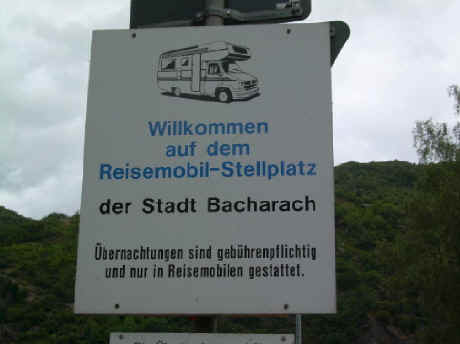
In our context, these terms refer to overnight parking/sleeping areas for self-contained motorhomes. A very interesting facility, they are not generally found in North America. Some are rudimentary - not much more than a parking spot, some have electric, water & a dump station. Some are free, some cost perhaps 16 Euros (always less than the nearest campground). They are usually in very good locations relative to city & town centres.
Here's an excellent descriptive page of French Aires: Mini-guide to Aires in France
And one for German Stellplätze: Mini-Guide to German Stellplätze
I purchased some Stellplatz/Aire guides, most notably
a) The premier German guide (POIs for GPS available on their site as well): Bord Atlas
b) A French guide: Guide Officiel des Aires de Services Camping-car
c) The German AAA offers : ADAC Stellplatz Fuhrer
d) Excellent French site - also has GPS & USB stick downloads: campingcar infos
e) 2017: I now use an app: Campercontact. And there are other apps.
Additionally, in France there is a great organization called France Passion - membership provides no-charge overnighting on private land - usually a vineyard or a farm. There are more rudimentary versions of this in Italy ( Fattore Amico & GreenStop ), Spain (ESPAÑA DISCOVERY) .
Maps
The Michelin atlas is a must. I have all-Europe, plus I often pick up a country-specific edition.I now also have Philips Big Atlas & ADAC Caming & Stellplatz.
Additionally several apps have offline maps for use in a GPS equipped tablet or phone. I have maps me, viago z& here - and there are others.
We use a Garmin Nuvi 770 GPS - this model & its replacements have both Euro & N. American maps. We download free stellplatz POIs from Campercontact (also available from Bordatlas & campingcar infos).
Storage
If you're going to leave your vehicle in Europe for a time, figure out convenient storage. Note that there are restrictions on length of stay in the Schengen grouping of countries within Europe. Do your own due diligence on this matter. Tom & Judy Salmon have a clear explication on their Papillon site: Click Here
Propane (LPG or GPL)
There are a few different nozzles used in Europe - you can buy them, but I found on our previous trips that many stations had them - I never actually used the ones I carried with me. The German filler nozzle ( 1 3/4" acme ) is exactly the same as ours, as is the old-style Belgian nozzle, still to be found at most pumps in that country: Click Here For Pictures of various adaptors
Communications on the road
UPDATE 2017: we use Android cell phones/tablets with a Canadian roaming package attached & several windows/android/apple tablets & phones. Wifi is now practically ubiquitous, so we save on roaming by using wifi where possible. We've also tried international SIMs and local SIMs, but this landscape is changing with the intro in 2017 of no roaming charges in the EU, so we have no recommendations here.
Taking Your Dog : WE NOW Have a Separate page FOR THIS: Flying Your Dog
DUMPING
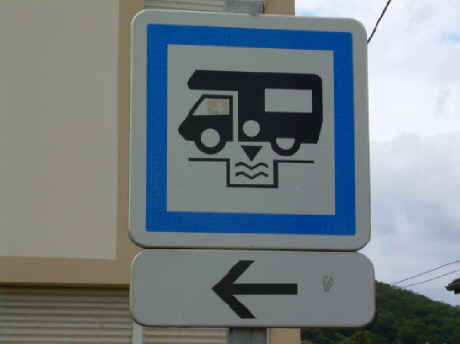
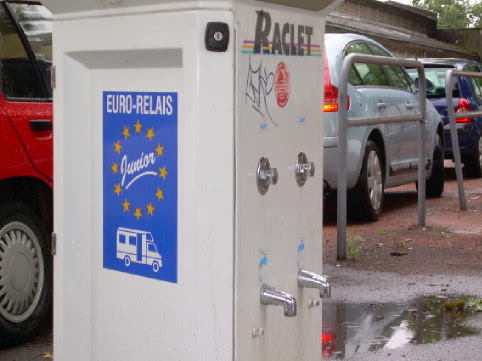
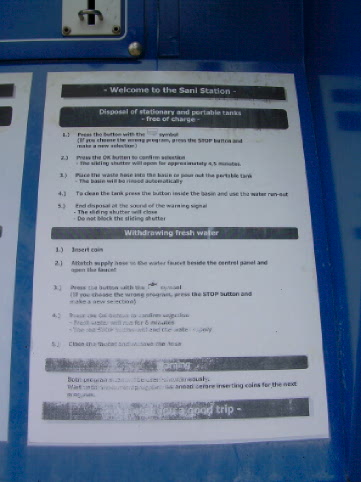
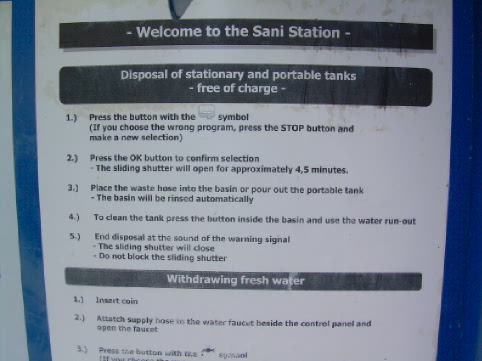
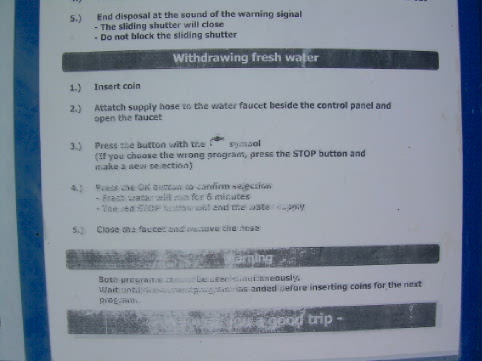
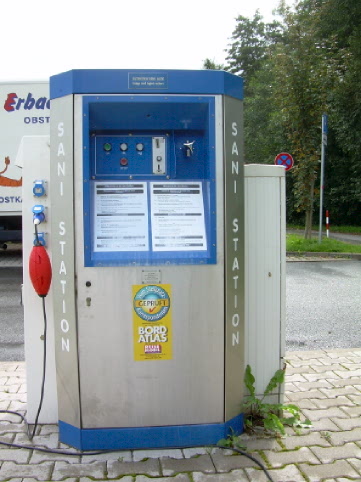
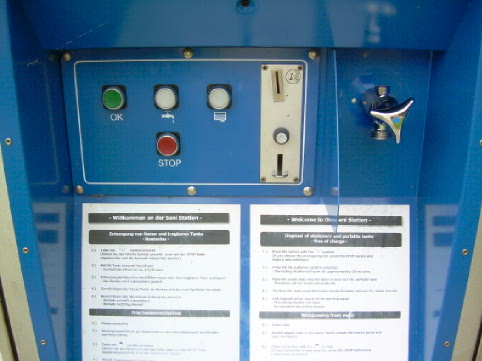
In many places, especially aires & stellplatz, you will find an island with a metal self-serve utilities centre - it dispenses fresh water, electricity and provides for the discharge of the tanks. In France they seem to be called "Flot Bleu" or "Euro Relais" and we have found them in parking lots, aires, on the lots of hypermarches like Leclerc or even just by the side of the road. Just follow the signs picturing a motorhome with a dump symbol below it. In Germany they seem to be attached to a stellplatz. Some have been free, some require a Euro or 2 deposited in a box on the honour system, some are coin-operated, some accept credit cards.